
ENGINEERING STORY 007
Before You Book
the AI Saving
AI may make engineering dramatically cheaper. But what will it cost us to know that the engineering is correct?
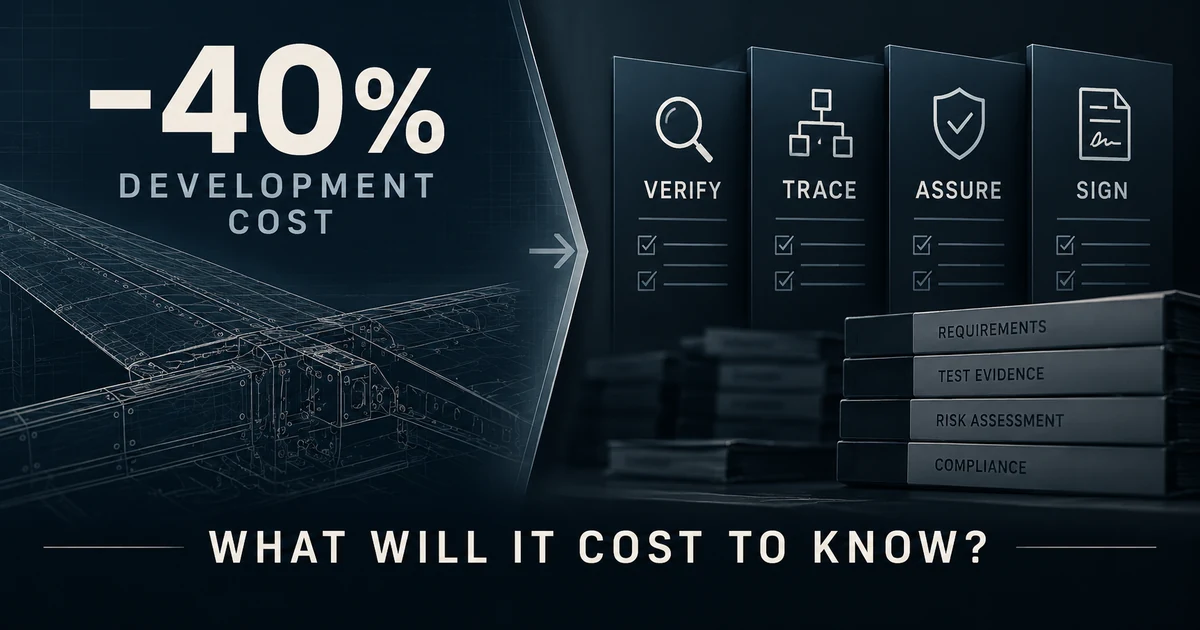
The numbers could be irresistible.
A company develops complex products. Development takes years, requires large engineering teams and costs millions.
Then somebody demonstrates what artificial intelligence can do.
Requirements can be drafted faster. Designs can be developed. Software can be generated. Test cases can be written. Documentation that once took days can appear in minutes.
The potential saving is enormous.
So the question from the boardroom is perfectly reasonable.
Why aren't we using it?
Perhaps we should be.
But before putting the saving into the business case, engineering needs to answer another question.
What will it cost us to know that the engineering is correct?
THE OPPORTUNITY
This isn't an argument against AI.
Quite the opposite.
If AI allows engineers to develop products faster, eliminate repetitive work and reduce development costs, we should exploit it.
Engineering has always adopted better tools.
We moved from drawing boards to CAD, from hand calculations to simulation, and from manually produced documents to integrated engineering environments.
AI may simply be the next enormous step.
But there is a difference between a tool making an engineer more productive and a tool actually producing engineering artefacts upon which the safety of a product depends.
At some point, we have to decide where that boundary sits.
THE OTHER HALF
Producing it is only half the job.
Imagine AI produces a piece of safety-related software in an afternoon that would previously have taken an engineering team several weeks.
That's an impressive saving.
But what happens next?
Someone still has to demonstrate that the software satisfies its requirements.
Someone needs to know that assumptions haven't silently appeared in the design.
Someone needs to verify its behaviour at the boundaries.
Someone needs to consider failure conditions.
Someone needs to produce evidence.
And eventually someone may have to put their name against the argument that the resulting product is acceptably safe.
So we have a choice.
We could independently verify everything the AI produces using suitably competent engineers.
That sounds reassuring.
But if engineers have to reconstruct, examine and independently verify all of the work, how much of the original saving remains?
There is another possibility.
Use AI to help with the verification as well.
Now the economics start looking attractive again.
But the engineering question becomes considerably more interesting.
VERIFICATION
Have we verified it?
Suppose AI helps interpret the requirements.
It produces the design.
It generates the software.
Another AI process creates the tests.
Those tests pass.
AI analyses the results and helps construct the assurance evidence.
Everything agrees.
Have we demonstrated that the engineering is correct?
Or have we demonstrated that several processes can reach the same conclusion?
Those aren't necessarily the same thing.
If the original interpretation contained a subtle error, could that same assumption find its way into the design, implementation and verification?
The requirements, design, software and tests might line up beautifully.
And still be wrong.
Engineers have worried about independence and common-mode failure for a very long time.
AI hasn't invented that problem.
It may simply have given us a new version of it.
INDEPENDENCE
What does independent mean?
Perhaps the answer is simply to use another AI for verification.
But then we need to decide what we mean by another.
A new conversation with the same model?
A separate instance of it?
A different model supplied by the same company?
A competing model?
A model trained using much of the same publicly available engineering knowledge?
At what point have we actually achieved meaningful independence?
I don't know.
But if the commercial saving depends upon AI being used on both sides of the development and verification boundary, somebody is going to have to answer it.
EXISTING WORK
We aren't starting from nothing.
There is already substantial work underway.
The UK's National Cyber Security Centre has published guidance covering the secure development and use of AI systems. It recognises that organisations may train their own models, adapt existing ones or use externally supplied models and services. It also emphasises supplier due diligence, model provenance, limitations and appropriate controls.
The UK government's work on AI assurance makes another important point: there isn't a single assurance technique that makes AI trustworthy. Different techniques need to be combined, with the level of assurance reflecting the level of risk.
The US National Institute of Standards and Technology has developed its AI Risk Management Framework and specific guidance for generative AI.
And in aviation, EASA continues to develop its approach to AI in an industry where demonstrating safety is already fundamental to product development.
So this isn't an undiscovered problem.
There are serious people doing serious work on it.
But for the engineering organisation considering AI today, there remains a very practical question.
THE BUSINESS CASE
When do we book the saving?
Imagine a business case claiming that AI will reduce engineering development costs by 40 per cent.
Perhaps it will.
But what assumptions sit behind that number?
Does it assume human verification of AI-generated engineering?
Does it include additional assurance activities?
Does it account for configuration and traceability of the AI tools themselves?
What happens when the model changes during a five-year development programme?
Does the assurance argument depend upon knowing which model produced which engineering artefact?
And if independent human engineering has to be retained alongside AI-generated engineering, has that cost been included?
These aren't reasons not to use AI.
They are reasons to understand the complete engineering system before claiming the saving.
Because development cost and assurance cost aren't separate problems.
They are part of the same business case.
THE AWKWARD QUESTION
What will it cost us to know?
AI may radically reduce the cost of engineering.
I hope it does.
It may allow smaller engineering teams to accomplish things that previously required enormous organisations. It may remove repetitive work and allow engineers to spend more time thinking about the difficult problems.
There is potentially enormous value here.
But before putting that saving into next year's budget, I would want one question answered.
What evidence will we require before we trust the engineering AI produces?
Because if humans must independently reproduce most of the work to provide that confidence, some of the saving disappears.
And if AI provides the independent verification to preserve the saving, we need to understand what independent now means.
THE POINT
The question isn't whether AI can do the engineering.
The question is what it will cost us to know that the engineering is correct.
I don't know the answer.
And perhaps, at this stage, none of us completely does.
So here is the question I would put to engineering managers, safety engineers, regulators and anyone currently building AI into their development processes.
Before you put the AI saving into the business case, what would your assurance organisation need to see before it signed its name against the result?
I'd genuinely like to know.
DISCUSSION
What do you think?
Engineering gets better when ideas are challenged. Share your view, experience or disagreement.
ENGINEERING STORIES
Leave a comment
Comments are reviewed before publication. Your email address is optional and will never be published. How comments are handled.