
ENGINEERING STORY 006
If only the number
changes, stop.
Cost challenge is part of good engineering. But management also needs to know when to stop pressing.
A reservoir being built in Hampshire has provided a familiar headline.
The cost of Havant Thicket Reservoir has risen dramatically.
The natural reaction is equally familiar.
How can professional engineers and project managers get the cost of a major project so badly wrong?
It is a reasonable question.
But it may not be the most useful one.
Was it ever really the project we originally priced?
THE PROJECT CHANGES
Major projects rarely emerge fully formed.
At the beginning there is a requirement, a concept, some preliminary engineering and an estimate.
Then people start discovering things.
Interfaces turn out to be more complicated than expected. Operational requirements emerge. Regulators become involved. Ground investigations reveal something inconvenient. Resilience requirements develop. Suppliers expose assumptions that nobody realised were assumptions.
And sometimes the required capability itself grows.
Havant Thicket illustrates several of these effects. The original reservoir was designed around supplying 21 million litres a day. Subsequent integration with Southern Water's wider Hampshire water-transfer plans required significant changes, including additional pipeline and interface works.
Construction also revealed ground conditions that Ofwat's technical advisers concluded could not reasonably have been foreseen from the original investigations.
So the project changed.
SCOPE
Scope creep and scope discovery are not the same thing.
Scope creep is where people keep adding things that would be nice to have.
Scope discovery is where engineering gradually reveals what is actually necessary to deliver the required capability.
They are not the same thing.
But both cost money.
THE PRESSURE
None of this means engineers should simply get whatever budget they ask for.
Quite the opposite.
Cost pressure is healthy.
Engineers can be conservative. We can prefer technically elegant solutions. We sometimes protect ourselves against uncertainty. Given an unlimited budget, there is always the danger of producing a magnificent solution to a problem that could have been solved more simply.
Management therefore has every right to challenge an estimate.
Why does it need to cost this much?
Are we gold-plating it?
Can we simplify this?
Do we really need that requirement?
Those questions can save enormous amounts of money.
The difficulty is knowing when to stop asking them.
THE ESTIMATE
Something changes during the conversation.
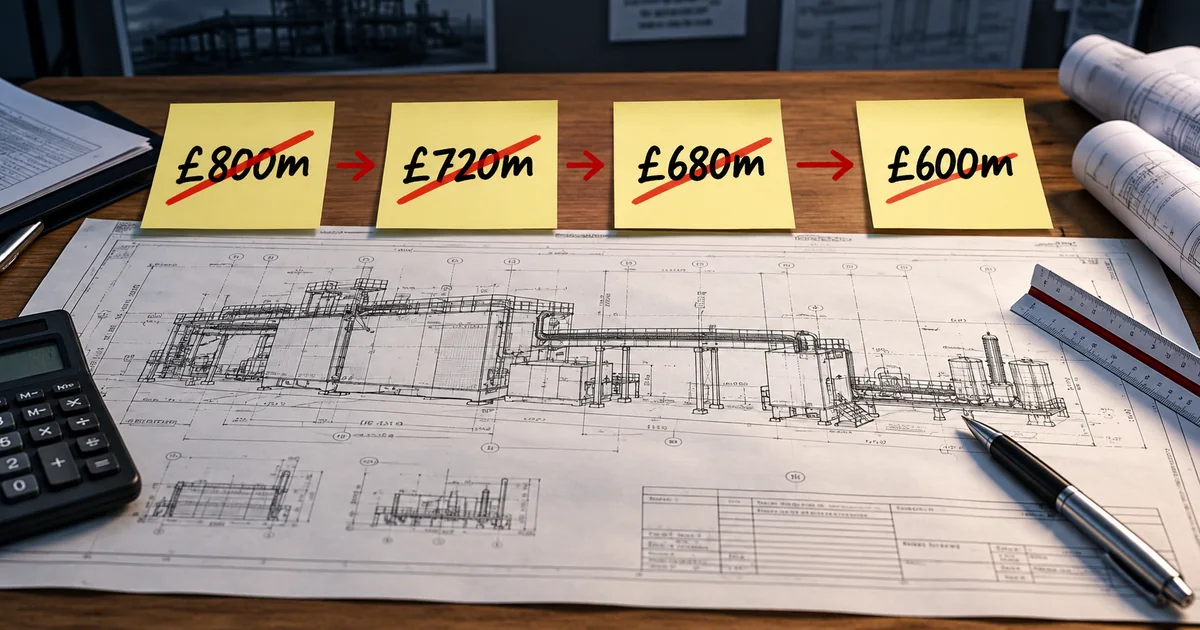
Imagine engineering estimates a major project at £800 million.
Management says that is unaffordable.
Go away and look again.
The engineers do.
A requirement is simplified. A design changes. An interface disappears. A supplier proposes a better construction method.
The estimate falls to £720 million.
Excellent.
Management challenges again.
More work is done. More genuine savings are found.
£680 million.
Then the conversation begins to change.
The obvious savings have gone.
Contingency is challenged. An uncertain requirement is assumed not to materialise. A difficult interface will be resolved during detailed design. A risk is transferred to the contractor. The programme becomes a little more ambitious.
Perhaps £620 million can be made to work.
Nothing improper has necessarily happened. Every assumption can probably be defended.
But notice what has changed.
Earlier reductions changed the engineering.
Later reductions may only have changed the confidence with which we describe the future.
THE DANGER
Eventually engineers stop arguing.
This is one of the most dangerous moments in a major project.
Engineers do not have unlimited appetite for fighting the same battle.
If senior management repeatedly says an estimate is too conservative, contains too much contingency or represents a gold-plated solution, eventually the engineering team may stop pushing back.
Fine. We'll do our best to deliver it for £600 million.
The meeting becomes considerably easier.
The project becomes affordable. The business case can proceed.
Management may even believe that persistent challenge has finally exposed excessive engineering conservatism.
But did the engineers change their minds, or did they simply stop arguing?
The spreadsheet cannot tell you.
A BETTER CHALLENGE
Challenge the assumptions, not the answer.
When an engineering estimate appears too high, don't simply demand a lower number.
Ask: What would have to be true for this project to cost less?
That forces the conversation back towards evidence.
Perhaps the ground conditions need to be better understood. Perhaps a regulator needs to confirm an interpretation. Perhaps an interface can be prototyped. Perhaps another survey can establish whether an expensive modification is actually necessary. Perhaps a requirement can genuinely be removed.
Spend money answering those questions.
A few million pounds spent reducing uncertainty before committing hundreds of millions can be extremely good value.
The objective should not be to remove contingency from the spreadsheet. It should be to remove the reason the contingency existed.
THE TEST
Every reduction should have an explanation.
There is a simple discipline senior management can apply.
Whenever the estimate falls materially, ask: What changed?
If a requirement disappeared, the design became simpler, a survey provided better information, a risk was genuinely retired, a supplier demonstrated a cheaper method or a prototype proved an assumption, then the project really may have become cheaper.
Keep challenging.
But eventually the answers start sounding different.
We have reduced the contingency.
We think we can manage the risk.
We are assuming that won't happen.
The contractor has accepted it.
We'll resolve that later.
Those statements may be perfectly legitimate project decisions.
But they are not necessarily cost reductions.
Sometimes they merely move uncertainty somewhere else.
And moving a risk does not make it disappear.
THE STOP RULE
Management needs its own stop rule.
Engineers are routinely expected to know when a design is good enough.
Management needs an equivalent discipline for cost challenge.
There comes a point where further pressure stops removing unnecessary engineering and starts removing honesty from the estimate.
Recognising that point is part of good project leadership.
What changed in the project that makes the previous estimate wrong?
If there is a convincing engineering answer, continue.
If nothing has changed except the number, stop.
That does not mean accepting every engineering estimate without challenge. It means recognising when challenge has done its job.
THE UNCOMFORTABLE QUESTION
Was the eventual cost always hiding somewhere in the project?
When a project originally associated with a few hundred million pounds eventually approaches twice that amount, newspapers understandably describe it as an overrun.
Sometimes that is exactly what it is.
Poor estimating exists. Weak project control exists. Gold-plating exists. Bad procurement exists. Uncontrolled scope creep certainly exists.
But there is another possibility worth examining.
Some of the eventual cost may always have been inherent in delivering the capability.
It simply wasn't visible, understood or acceptable when the first number was produced.
When did we actually know enough about this project to know what it was going to cost?
If the answer is after we had already committed ourselves to building it, the problem started long before the cost overrun appeared.
THE POINT
Major projects need both kinds of challenge.
Without financial challenge, engineering can become unnecessarily expensive.
Without engineering challenge, financial targets can become unnecessarily optimistic.
Major projects need both.
The skill is maintaining that tension without allowing either side to win the argument simply through exhaustion.
Management should keep asking engineers to make a project cheaper.
Engineers should keep demonstrating what must change to achieve it.
But there has to be a stopping point.
Keep challenging the engineers until the engineering changes.
If only the number changes, stop.
Cost pressure is part of good engineering. Knowing when that pressure has stopped improving the engineering is part of good leadership.
DISCUSSION
What do you think?
Engineering gets better when ideas are challenged. Share your view, experience or disagreement.
ENGINEERING STORIES
Leave a comment
Comments are reviewed before publication. Your email address is optional and will never be published. How comments are handled.