
ENGINEERING STORY 011
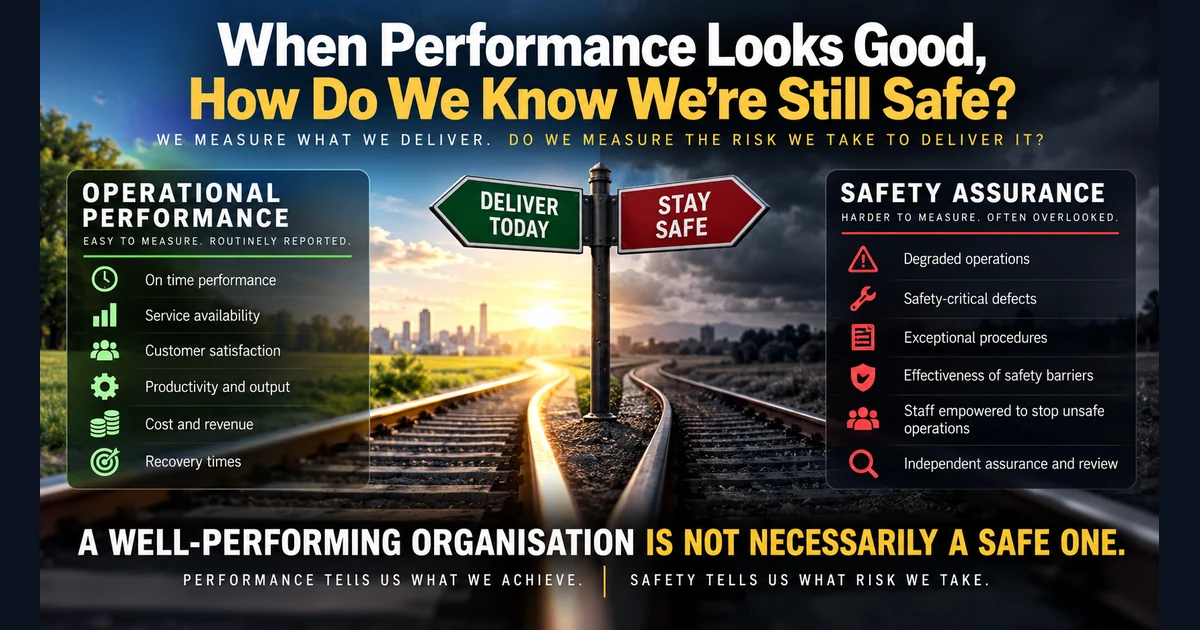
When Performance Looks Good, How Do We Know We're Still Safe?
We measure what we deliver. But do we measure the risk we take to deliver it?
The recent railway tragedies in Spain are a sobering reminder of why safety-critical engineering matters.
The investigations must be allowed to establish what happened, why it happened and what lessons should be drawn. It would be wrong to assume that the incidents share a common cause or to draw conclusions about the organisations involved before the evidence is available.
But there is a wider question worth asking now.
How confident are we that the systems and organisations we manage are as safe as their operational performance suggests?
That question extends far beyond railways.
It applies to aviation, healthcare, energy, defence, manufacturing, transport and almost any industry where failure can have serious consequences.
We should not have to experience our own catastrophe to learn from somebody else's.
THE PRESSURE TO KEEP THINGS MOVING
The pressure to keep things moving
Every operational organisation faces pressure to deliver.
Trains must run. Aircraft must fly. Hospitals must treat patients. Power must remain available. Production must continue.
There is nothing inherently wrong with that pressure. These services exist because people depend upon them, and interruptions have real consequences.
The difficulty arises when operational performance becomes the dominant measure of organisational success.
Punctuality, availability, productivity, recovery times and financial performance are relatively straightforward to measure. They appear in management reports, performance dashboards and executive presentations.
Managers are questioned when those figures deteriorate.
But what happens when the safety arrangements supporting those results begin to deteriorate?
A safety-critical defect might remain unresolved for longer than intended. A temporary operating restriction might become familiar. An exceptional procedure might be used so frequently that nobody regards it as exceptional any more.
Operations continue, and the performance figures may still look good.
Indeed, the organisation might be congratulated for maintaining its service despite the difficulties.
Yet the conditions under which that performance is being achieved may have changed considerably.
Good operational performance does not necessarily demonstrate good safety performance.
ENGINEERING ASSURANCE
Degraded operation is still safety-critical operation
Most safety-critical systems are designed around an intended operating condition.
We analyse hazards, establish safety requirements, design protective measures, verify their implementation and demonstrate that the resulting system is acceptably safe for its intended use.
But real systems do not spend their entire lives operating exactly as intended.
Equipment fails. Components become unavailable. Maintenance is deferred. Information is incomplete. Communications are interrupted. Systems are operated under temporary restrictions.
We call this degraded operation.
Degraded operation is not necessarily unsafe. Many systems are specifically designed to tolerate failures while maintaining an acceptable level of safety.
The important distinction is whether the degraded condition has been properly analysed, whether its limits are understood and whether the necessary controls remain effective.
For example, an operation might be permitted to continue with reduced technical protection, provided that additional procedural controls are introduced.
That can be a perfectly legitimate engineering decision.
But procedural controls depend upon people recognising the situation, understanding the instructions, maintaining attention and responding correctly under operational pressure.
They may not provide the same reliability as the technical protection they replace.
If a temporary arrangement becomes routine, its assumptions deserve renewed scrutiny.
Has the operating environment changed? Are the people involved adequately trained? Are the procedures still appropriate? Are the restrictions being followed? Has the degraded condition persisted longer than the original safety assessment anticipated?
Most importantly, is the organisation still operating within the conditions under which continued operation was judged acceptable?
Degraded operation needs its own safety assurance. It cannot simply inherit the assurance established for normal operation.
WE MEASURE PERFORMANCE. BUT DO WE MEASURE THE SAFETY MARGIN?
We measure performance. But do we measure the safety margin?
Imagine an executive performance dashboard.
It might show service availability at 99.8%, excellent punctuality, improved productivity, reduced costs and faster recovery from disruption.
All encouraging results.
Now imagine a second dashboard.
It shows the number and age of unresolved safety-critical defects, the frequency and duration of degraded operation, the effectiveness of critical safety barriers, outstanding safety actions and the number of occasions when operations have continued under exceptional arrangements.
Would the second dashboard receive the same attention as the first?
Would an adverse movement in those indicators trigger the same executive scrutiny as a fall in availability or an increase in operating costs?
Many safety-critical industries already collect substantial amounts of safety information. There are established approaches to hazard management, safety performance indicators, risk assessment, independent assurance and operational monitoring.
The problem is not necessarily a lack of methods or data.
It is whether the information is being used to support meaningful management decisions.
And we must be careful about what those measurements actually tell us.
Counting outstanding defects is not the same as measuring the risk they represent. A small number of serious defects may matter more than a large number of minor ones.
Similarly, a low incident rate does not prove that critical safety barriers are healthy. Serious accidents are fortunately rare, and their absence is not, by itself, evidence that the underlying risks are adequately controlled.
Leading indicators, barrier assessments and operational evidence can help, but they require engineering interpretation.
Where we have measured evidence, we should say so.
Where we have a model or an estimate, we should identify its assumptions and limitations.
And where we are relying upon engineering judgement, we should be equally clear.
The objective is not to produce another reassuring dashboard. It is to understand whether the organisation remains within its accepted safety boundaries.
ENGINEERING ASSURANCE
Safety culture is revealed when things go wrong
Almost every safety-critical organisation declares that safety is its first priority.
That is an admirable commitment.
But the real test of that commitment is not what happens when everything is working correctly.
It is what happens when something goes wrong.
Consider an operational disruption.
A system has failed, customers are affected, schedules are deteriorating and management wants to know when normal service will resume.
The immediate questions are understandable.
What has failed? How quickly can it be repaired? Is there an alternative operating arrangement? How much disruption can be avoided?
But one question must take precedence.
Have we established that it is safe to get things moving again?
That is subtly different from asking how quickly operations can resume.
A healthy safety culture gives the people responsible for safety the authority, information and support to answer that question properly.
It also accepts that the answer may be inconvenient.
Sometimes the correct engineering decision is to restrict operations, reduce capacity or stop altogether until the necessary assurance has been established.
That decision may be commercially painful.
It may frustrate customers and attract criticism.
It may even make the organisation's operational performance appear worse than that of a competitor willing to accept greater uncertainty.
But safety cannot genuinely be the first priority if the people making those decisions believe they will be penalised for exercising that responsibility.
THE DANGER OF MEASURING ONLY WHAT IS CONVENIENT
The danger of measuring only what is convenient
Management behaviour is influenced by what organisations choose to measure and reward.
This does not mean that managers deliberately encourage unsafe decisions.
Usually, the influence is much more subtle.
An organisation celebrates rapid recovery from disruption. Teams are praised for finding ways to maintain service. Managers are rewarded for meeting demanding performance targets.
Over time, people learn what successful behaviour looks like.
If an operating workaround repeatedly avoids disruption, it may gradually become accepted practice.
If an unresolved defect has caused no obvious harm, its urgency may diminish.
If raising a safety concern consistently produces delays, difficult meetings and unwelcome attention, people may become reluctant to raise the next one.
Nobody needs to issue an instruction to compromise safety.
The organisation's expectations can create pressure of their own.
This is one reason why safety culture cannot be assessed simply by reading policies, examining training records or asking whether employees believe safety is important.
We need to examine actual decisions.
When safety and operational performance conflict, what happens?
Who has the authority to stop an operation?
What evidence is required before restarting?
Are concerns investigated or explained away?
Are temporary deviations independently reviewed?
Do senior managers understand the cumulative effect of operating with multiple degraded protections?
And are those who make cautious, defensible decisions supported even when the consequences are expensive?
These questions reveal considerably more than a statement on a corporate website.
ENGINEERING ASSURANCE
Learning from somebody else's accident
Whenever a serious accident occurs, there is a natural tendency to concentrate on the immediate technical cause.
Was a component defective? Did a signalling system fail? Was a procedure followed? Did somebody make a mistake?
Those questions matter enormously, and investigators must establish the evidence.
But the wider engineering lessons often extend beyond the immediate sequence of events.
Why did the relevant protections fail to prevent the outcome?
What assumptions were made about the reliability of equipment, procedures or human intervention?
Were degraded conditions properly understood?
Did earlier warnings exist, and how were they interpreted?
Were safety decisions influenced by operational expectations?
Did management have sufficient visibility of the condition of the system's safety barriers?
Not every accident involves failures in all these areas. Nor should we assume that any particular factor contributed to the recent events in Spain.
The point is that these are useful questions for every safety-critical organisation to ask about its own operations.
A railway accident may reveal a lesson relevant to aviation.
An aviation incident may expose a weakness that matters in healthcare.
A chemical plant accident may demonstrate a management or assurance failure that could equally arise in energy infrastructure.
The technologies differ, but the underlying engineering challenges often have much in common.
Complex systems depend upon layers of protection, reliable information, competent decisions, clear responsibilities and an organisation willing to respond when its assumptions are challenged.
We should not wait for an investigation to identify a failure in our own industry before asking whether the same weakness exists in our systems.
WHAT SHOULD WE BE DOING DIFFERENTLY?
What should we be doing differently?
I do not believe the answer is another universal safety score or a more elaborate five-by-five risk matrix.
Safety is too complex to be reduced to a single number that management can treat as definitive.
A more useful approach is to establish a small number of meaningful questions and ensure that the organisation can answer them with credible evidence.
Do we know which safety barriers are critical to our operations, and can we demonstrate that they remain effective?
Do we understand how often we operate in degraded conditions, why those conditions arise and how long they persist?
Can we identify safety-critical defects whose unresolved status changes the risk of continued operation?
Are the assumptions behind temporary procedures and operating restrictions still valid?
Do we have clear criteria for restricting, stopping and restarting operations?
Can employees raise safety concerns without being pressured to prioritise service delivery?
And does executive management review this information with the same seriousness as financial and operational performance?
The answers will differ between industries and organisations.
The evidence might come from engineering assessments, maintenance records, operational monitoring, independent audits, safety cases or structured reviews of safety-critical decisions.
What matters is that the measures are connected to actual hazards and safety controls, rather than selected simply because the data is easy to collect.
They should also help identify deteriorating conditions before those conditions contribute to an accident.
We must be particularly wary of indicators that look reassuring while the system's underlying resilience is being eroded.
A measure is useful only if it helps somebody recognise a problem and take an appropriate decision.
ENGINEERING ASSURANCE
A final thought
Operational performance matters.
Availability matters. Productivity matters. Recovery matters. Delivering reliable services matters.
But none of these achievements is sufficient if the conditions under which they are delivered are becoming progressively less safe.
A well-performing organisation is not necessarily a safe organisation.
And an organisation that occasionally stops, restricts or delays operations because its engineers cannot establish adequate safety may be demonstrating exactly the culture we should want to encourage.
The challenge for management is to make safety performance as visible, as discussable and as consequential as operational performance.
Not by pretending that safety can be captured in one convenient number, but by ensuring that the condition of the organisation's critical protections is understood at every level where decisions are made.
If safety really is our first priority, why isn't its performance reported alongside operational performance, with the same visibility and scrutiny?
The most valuable safety improvement is the one made before an accident proves it was necessary.
DISCUSSION
What do you think?
How does your organisation monitor safety barriers and degraded operations? What measures influence management decisions?
Join the discussion
Comments are moderated before publication.
ENGINEERING STORIES
Loading comments...