
ENGINEERING STORY 009
If We Designed Air Traffic Control Today,
Would We Build Radar?
Before improving every part of today's air traffic system, perhaps we should ask whether we would design the same system at all.
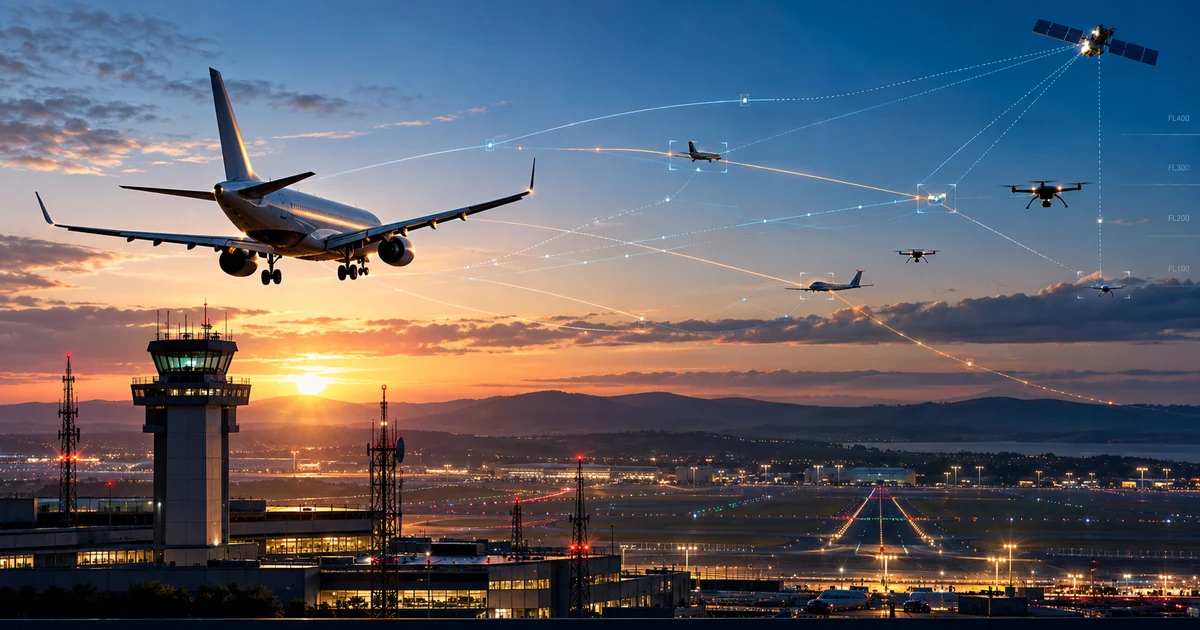
For most of aviation's history, knowing where an aircraft was meant finding it.
Primary radar detected it. Secondary surveillance radar interrogated it. Mode S improved the conversation. ADS-B allowed aircraft to report considerably more information about themselves.
It is an architecture that has served aviation extraordinarily well.
But suppose none of it existed.
Suppose we were asked today to design a system capable of safely managing everything from an airliner crossing the Atlantic to an autonomous drone flying across a city.
Would we build the system we have now?
I'm not sure we would.
START WITH THE REQUIREMENT
Start at the top.
There is a trap when modernising any successful system.
We tend to divide its future between the people who understand the components of its present.
Surveillance specialists improve surveillance.
Communications specialists improve communications.
Controllers improve controller tools.
Drone specialists develop unmanned traffic management.
Satellite specialists improve connectivity.
Regulators develop rules around each of them.
Every individual development may be excellent.
But put all those improved pieces back together and there is a danger that we simply recreate today's architecture using newer technology.
That is evolution from the bottom up.
Perhaps we should occasionally do the opposite.
Forget, temporarily, how today's system works and ask what the future system actually needs to achieve.
It needs to know what is using the airspace.
It needs sufficient confidence in where those vehicles are and where they intend to go.
It needs to prevent unacceptable conflicts.
It needs to recognise uncertainty.
It needs to continue operating safely when parts of the system fail.
And it needs to cope with a number and variety of air vehicles that the original designers of air traffic control could never have contemplated.
Only after defining those requirements should we decide what technologies, organisations and human roles are needed underneath them.
We might end up choosing radar, controllers, sectors and many of today's organisational arrangements.
But we might not.
When designing the replacement for a successful system, be careful not to turn the existing solution into a requirement.
CHANGE THE QUESTION
The aircraft already knows quite a lot.
A modern aircraft doesn't need radar to tell it where it thinks it is.
It knows its position, altitude, velocity and heading. Its flight management system may contain a detailed description of where it intends to go.
Increasingly, air traffic management can work with the idea of a four-dimensional trajectory: where an aircraft expects to be in latitude, longitude and altitude, and when it expects to be there.
Communications are changing too.
Satellite constellations, terrestrial networks and aviation-specific data links increasingly offer ways of exchanging information over very large distances.
So it is reasonable to ask what happens if we turn the traditional surveillance problem around.
Instead of the ground continually asking:
Where is that aircraft?
the aircraft could increasingly be saying:
This is who I am.
This is where I am.
This is where I intend to go.
This is when I expect to get there.
That information need not necessarily be destined for a controller.
It could contribute to a much wider, continuously updated model of the airspace.
Pieces of this thinking already exist in trajectory-based operations, digital information exchange and emerging unmanned traffic-management systems.
But joining the pieces together creates some interesting problems.
TRAJECTORY MANAGEMENT
Stop separating aircraft?
Traditional air traffic control frequently resolves potential conflicts tactically.
Change a heading.
Change a level.
Change a speed.
Change a route.
If sufficiently reliable trajectory information is available, another possibility emerges.
Perhaps the system should increasingly prevent trajectories from conflicting in the first place.
Two trajectories occupy the same piece of airspace at the same time.
Change one.
Recalculate.
Problem solved?
Unfortunately, no.
PROCESSING
The calculation isn't free.
There is an attractive simplicity to saying that when two trajectories conflict, we should modify one and check again.
Real systems are considerably less obliging.
My own experience with trajectory-based tools demonstrated an uncomfortable characteristic of the problem.
Changing one trajectory doesn't affect only that aircraft.
Its relationship with other trajectories must be recalculated. Those interactions may have changed. Resolving one of them may affect others.
The calculation can propagate.
Now increase the number of aircraft.
Add drones and autonomous vehicles.
Increase the amount of trajectory information.
Look further ahead.
Allow the system to consider multiple possible resolutions.
Modern processors are enormously more capable than those available when earlier trajectory-based systems were developed.
But the size of the problem is increasing too.
At what point does trajectory management itself become a scaling problem?
And, more importantly, what architecture would prevent it becoming one?
I'm deliberately not going to answer that.
TRUST
An aircraft saying where it is doesn't make it true.
There is another rather important problem with allowing aircraft to tell the system where they are.
They might be wrong.
GNSS can fail.
It can be jammed or spoofed.
Avionics can fail.
Software contains latent errors.
Communications can be delayed or lost.
A corrupted system can produce information that looks perfectly plausible.
So perhaps the future role of surveillance becomes rather interesting.
ADS-B, multilateration, primary radar and other independent surveillance sources need not merely tell the system where an aircraft is.
They can provide evidence that what the wider system believes is true.
If several genuinely independent sources agree, confidence increases.
If they disagree, the disagreement may be more important than any individual position report.
The difficult engineering question therefore becomes less:
How accurately can we determine where the aircraft is?
and more:
How does the system know when it can no longer trust where it thinks the aircraft is?
Again, that question is more interesting than pretending we already have the answer.
COMMUNICATIONS
Connectivity isn't the system.
It would also be very easy to become distracted by satellite communications.
Low-Earth-orbit networks are particularly interesting because they offer another potential communications path between aircraft and ground systems.
But making any particular commercial or aviation network fundamental to the safety argument would recreate another old engineering mistake.
Networks fail.
Satellites fail.
Terrestrial communications fail.
Links become congested.
Packets arrive late.
The interesting requirement isn't that one particular network must always work.
It is that safety-critical information must reach wherever it is needed within whatever timing, integrity and availability requirements the eventual system demands.
How many independent paths are necessary?
What happens when they disagree?
How old can trajectory information become before it is no longer safe to use?
Those questions matter much more than the name painted on the satellite.
SCALE
Then there are the drones.
This may ultimately force the issue.
A future containing very large numbers of unmanned aircraft cannot reasonably depend upon a human controller communicating individually with every vehicle.
Something different has to happen.
Emerging unmanned traffic-management concepts already point towards digital authorisation, identification, traffic information and strategic deconfliction.
But there is another potential trap here.
If we design one architecture for conventional aviation and another for unmanned aviation, are we simply creating two systems that someone will eventually have to join together?
An airliner and a delivery drone are obviously very different machines.
But both consume the same fundamental resource:
airspace at a particular time.
Perhaps the question isn't how drones should fit into today's air traffic system.
Perhaps it is what air-traffic system we need when both exist.
THE UNCOMFORTABLE QUESTION
And what happens to ATC?
This is where the discussion can become uncomfortable.
Organisations naturally tend to envisage futures in which their existing functions continue.
That isn't necessarily empire building.
If you ask people responsible for today's system to design its future, it is entirely reasonable that they begin with the system they know.
I've sat through enough discussions over the years to know that organisational responsibilities, boundaries and who retains which part of the problem can become remarkably important.
But they are not necessarily system requirements.
If machines can exchange trajectory information, detect many conflicts and resolve some of them automatically, while independent systems provide assurance that the underlying information remains trustworthy, we should at least be prepared to ask:
Which functions still require conventional air traffic control?
That does not mean controllers disappear.
Emergencies, abnormal operations, mixed-capability aircraft, busy terminal environments and degraded systems may require human involvement for a very long time.
But there is a substantial difference between asking:
How can ATC use these new technologies?
and asking:
Given these technologies, what functions does the future air-traffic system actually need?
The first question begins with today's organisation.
The second begins with the requirement.
Systems engineering should be prepared to ask the second question even when the answer is inconvenient.
RESILIENCE
Now break it.
Whatever architecture eventually emerges, this is where I would become interested.
Break it.
Jam the navigation source.
Lose a communications path.
Delay trajectory information.
Introduce disagreement between surveillance sources.
Lose a processing node.
Make an aircraft non-cooperative.
Give two parts of a distributed system slightly different versions of reality.
Then increase the traffic.
And keep increasing it.
What happens next?
A resilient system isn't simply one that rarely fails.
Its behaviour when things go wrong should be designed as carefully as its behaviour when everything works.
THE HUMAN FALLBACK
And eventually somebody will mention the human.
Imagine automation has been successfully managing an enormous number of trajectories.
A controller has been supervising the system but hasn't been tactically controlling those aircraft.
Then something happens that the automation can no longer safely manage.
The obvious safety argument is often:
Give it back to the human.
Fine.
What exactly are we giving them?
The controller may now have to understand an extremely complicated traffic situation that they didn't create and haven't been actively controlling.
How long do they have?
What information do they receive?
What has the automation already done?
What does it no longer know?
And how does the human establish sufficient situational awareness before making the next decision?
If the human is genuinely the final degraded mode, then human takeover isn't something we can add at the end of the design.
It becomes part of the architecture.
THE REAL QUESTION
Perhaps radar was never really the question.
I don't expect radar to disappear.
Indeed, independent surveillance may become even more valuable as aircraft and automated systems increasingly exchange their own position and trajectory information.
Nor am I suggesting that computers are about to replace air traffic controllers.
And I certainly don't have the architecture for the air traffic system of 2050 sitting on my desk.
That's rather the point.
Before designing that architecture, perhaps we should resist dividing the problem according to the technologies, organisations and professional boundaries that happen to exist today.
Start with the requirement.
Design the system from the top down.
Then bring in the extraordinary depth of expertise that exists across surveillance, communications, operations, human factors, regulation, software and aviation engineering to determine how those requirements should actually be met.
Because otherwise we risk spending enormous amounts of money successfully modernising every part of today's air traffic system.
And discovering that what we have built is...
today's air traffic system.
THE POINT
Perhaps the biggest obstacle to designing the air traffic system of the future isn't technology.
It is our tendency to begin the design with the air traffic system of today.
DISCUSSION
What do you think?
If we designed air traffic management from the requirements down, rather than today's architecture up, what would we keep? And what have I missed?
Join the discussion
Comments are moderated before publication.
ENGINEERING STORIES
Loading comments...